
What is an LEI?
...
Core Definition: A Legal Entity Identifier (LEI) is a 20-character code defined by the ISO 17442 standard. It identifies legal entities that take part in financial transactions and reporting.
On this page
Definition and Purpose
The LEI gives legal entities a standard identifier that can be used across markets, reporting systems, and jurisdictions. Each code links to reference data such as the entity's legal name, registered address, and registration details.
Regulators pushed for the LEI system after the 2008 financial crisis, when it was often difficult to tell which entities sat on either side of a trade. The system is backed by the G20 and overseen by the Regulatory Oversight Committee (ROC: ROC (Regulatory Oversight Committee) — an international group of public authorities providing oversight of the LEI system.) so firms and regulators can match counterparties more reliably across different jurisdiction: The country or legal area whose laws and regulations apply to an entity or activity..
Key Characteristics of the LEI:
- Standardized 20-character alphanumeric code (ISO 17442)
- Links to publicly available entity reference data (Level 1 data)
- Administered globally by the Global Legal Entity Identifier Foundation (GLEIF)
- Increasingly required for regulatory reporting across jurisdictions (e.g., MiFID II: MiFID II — an EU directive regulating financial markets, including transaction reporting and entity identification requirements (e.g., LEI usage)., EMIR: EMIR — an EU regulation focused on derivatives (especially OTC), including mandatory reporting to trade repositories.)
- Requires annual renewal to ensure data accuracy and active status
LEI reference data: Level 1 and Level 2
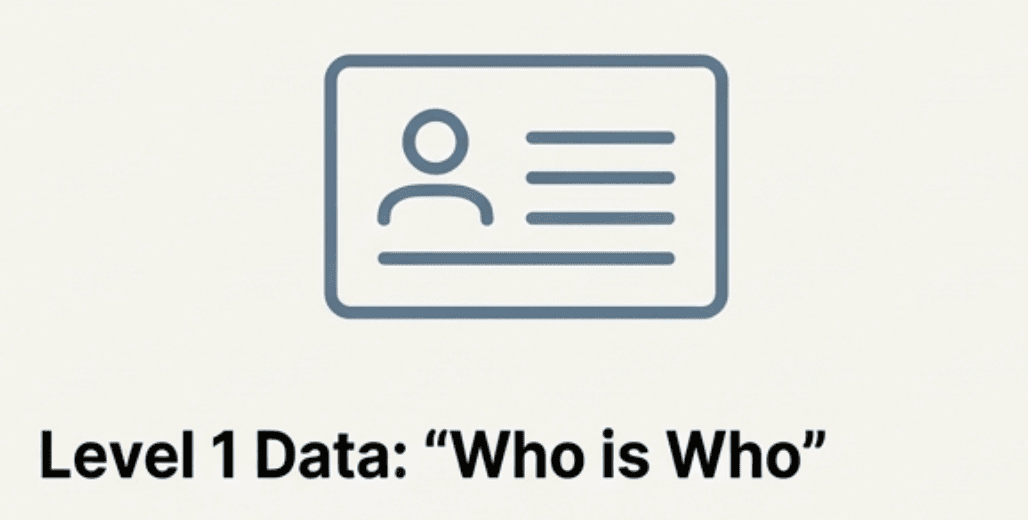
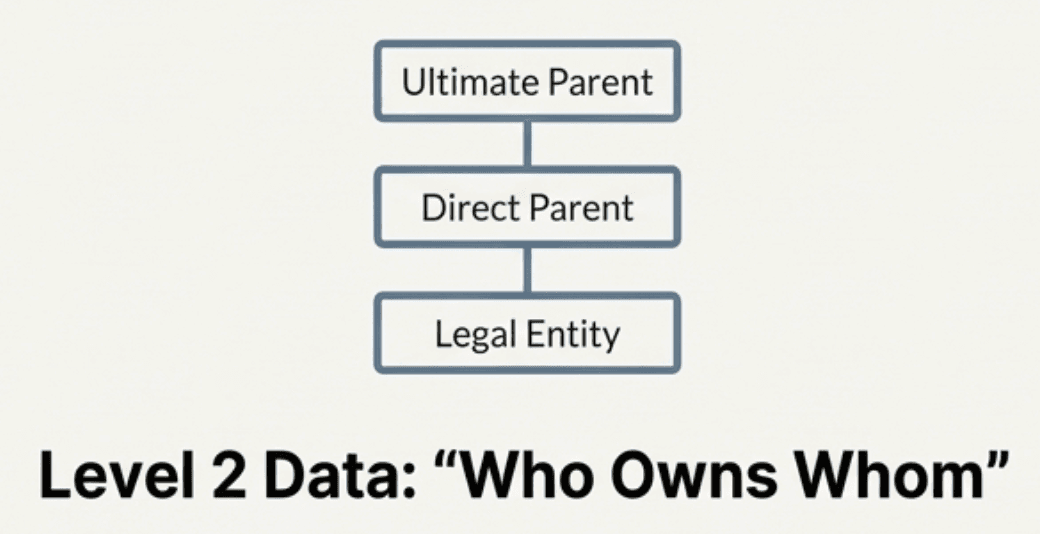
An LEI is not just a code. It links to public reference data that helps users identify an entity and, where available, its ownership relationships. This is commonly described as:
- Level 1 data (Who is Who): core identity data such as legal name, registered address, and jurisdiction.
- Level 2 data (Who owns Whom): relationship data describing direct and ultimate parent entities where applicable.
Entities Typically Requiring an LEI
An LEI is usually required when an entity trades certain instruments, files reports, or interacts with a regime that expects standardized entity data:
Financial Institutions
Banks, investment firms, credit institutions, and insurance companies often require LEIs for transaction reporting, regulatory filings, and risk aggregation purposes.
Corporate Entities
Companies engaging in financial market activities such as trading securities, derivatives: Financial contracts (e.g., forwards, futures, swaps, options) whose value is derived from an underlying asset, rate, index, or other reference. (including those under EMIR thresholds), or issuing financial instruments may need an LEI.
Investment Funds & Vehicles
Mutual funds, hedge funds, pension funds, special purpose vehicles (SPV: SPV (special purpose vehicle) — a legal entity created for a specific project or financial structure.), and other collective investment schemes often require LEIs under regulations like AIFMD: AIFMD — an EU directive regulating managers of alternative investment funds. or UCITS: UCITS — an EU regulatory framework for retail investment funds..
Structure of the LEI Code
The 20-character LEI code follows a defined structure specified by ISO 17442:
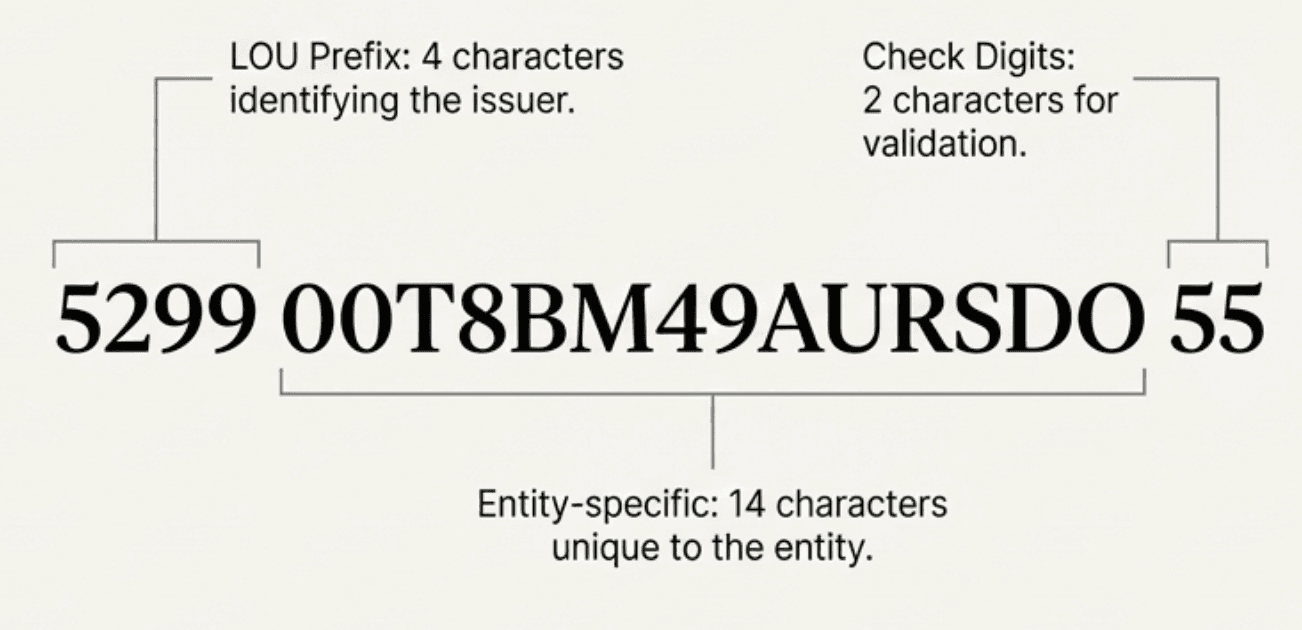
5493 00 1KJTIIGC8Y1R 17
(Example shown with notional spacing for clarity)
Characters 1-4:
Prefix assigned to the LEI issuer (Local Operating Unit - LOU: LOU (Local Operating Unit) — an accredited organization that issues/renews LEIs and validates entity data.).
Characters 5-18:
Entity-specific part of the code generated and assigned by the LOU.
Characters 19-20:
Two checksum digits calculated according to the ISO 17442 standard for verification.
The Global LEI System (GLEIS: GLEIS (Global LEI System) — the global framework of rules and institutions that supports issuing and publishing LEIs.)
The Global LEI System is the framework ensuring the operational integrity and accessibility of LEIs worldwide. Key components include:

- Global Legal Entity Identifier Foundation (GLEIF: GLEIF — the organization that coordinates the global LEI system and maintains data quality in the Global LEI Index.): A non-profit organization responsible for coordinating the system, ensuring data quality, and managing the network of LEI issuers.
- Regulatory Oversight Committee (ROC): A group of public authorities from around the globe providing governance and oversight of the GLEIS.
- Local Operating Units (LOUs): Organizations accredited by GLEIF to issue LEIs to legal entities, performing validation and ensuring data accuracy according to established protocols.
- Registration Agent: A service provider that helps entities register or renew an LEI (typically in cooperation with an LOU).: Organizations assisting entities in accessing LEI issuing services provided by LOUs.
Glossary (13)
- counterparty
- The other party to a transaction (e.g., a bank, fund, or company) that enters into the financial agreement with you.
- derivatives
- Financial contracts (e.g., forwards, futures, swaps, options) whose value is derived from an underlying asset, rate, index, or other reference.
- jurisdiction
- The country or legal area whose laws and regulations apply to an entity or activity.
- MiFID II
- MiFID II — an EU directive regulating financial markets, including transaction reporting and entity identification requirements (e.g., LEI usage).
- EMIR
- EMIR — an EU regulation focused on derivatives (especially OTC), including mandatory reporting to trade repositories.
- GLEIS
- GLEIS (Global LEI System) — the global framework of rules and institutions that supports issuing and publishing LEIs.
- GLEIF
- GLEIF — the organization that coordinates the global LEI system and maintains data quality in the Global LEI Index.
- ROC
- ROC (Regulatory Oversight Committee) — an international group of public authorities providing oversight of the LEI system.
- LOU
- LOU (Local Operating Unit) — an accredited organization that issues/renews LEIs and validates entity data.
- Registration Agent
- A service provider that helps entities register or renew an LEI (typically in cooperation with an LOU).
- SPV
- SPV (special purpose vehicle) — a legal entity created for a specific project or financial structure.
- AIFMD
- AIFMD — an EU directive regulating managers of alternative investment funds.
- UCITS
- UCITS — an EU regulatory framework for retail investment funds.
Next Steps
Now that the fundamentals of the LEI are clear, understand the practical steps involved by exploring how to obtain an LEI for your entity.